White Coat Syndrome and Antenatal Tests

How to recognise white coat hypertension

by Sophie Fletcher

One of my clients at the moment (I have permission to post this) is having a tough time of it. She is absolutely set on a homebirth, because she feels anxious in a hospital environment, but has been challenged every step of the way. Not overtly, as I’ve heard other mums being told – “it’s your first birth you can’t have a homebirth or “we’re too short staffed, you have to go into the hospital”. But her confidence is subtly being undermined by certain tests that will determine whether she is low or high risk and whether she will be ‘allowed’ to have a homebirth or not.  As she really wants a home birth these tests become a threat to her choice and consequently  the tests themselves cause anxiety, which can impact negatively on those test results.

This mum-to-be is excited about her baby’s arrival, has a wonderfully supportive husband, and is fully conscious of her connection with her little one. So it nearly broke my heart when she said last week,

“I guess I thought it would be a wonderful lovely experience and everyone working in that environment would be so full of love and positivity, its just taking me this long to realise that its just a job to most full of red tape, the ladies at Sainsburys checkout are happier and full of more love… what a shame.”

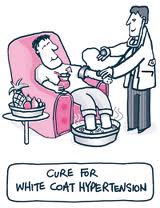
Ironically the stress being created by her treatment is probably causing more problems than if she were being treated with honesty and compassion.  Did you know that there is such a thing called white coat syndrome, which is a associated with people becoming more stressed in a clinical environment. Commonly it’s also called white coat hypertension in people with high blood pressure. Very often if someone has to go into hospital or to the doctors to have their blood pressure taken it goes up, if they take the machine home, their blood pressure can go down and be perfectly normal. The NICE guidelines on Hypertension note

“White Coat Hypertension (WCH) is reported to occur in as many as 25% of the population, especially where their BP is close to the threshold for diagnosis. It is more common in pregnancy and with increasing age. Failing to identify WCH makes inappropriate treatment for hypertension in normotensive patients a possibility. Similarly, hypertensive individuals can also exhibit WCH and may receive inappropriate dose titrations or additional antihypertensive agents. Patients have historically been enrolled in trials using clinic BP values, and these trials will almost certainly have included a proportion of patients with WCH. It is unknown whether benefits of treatment differ substantially in those with or without WCH.”

This study puts white coat hypertension as high as 32% in pregnant women.

White coat syndrome can affect pregnancy in several ways. Common antenatal tests such as gestational hypertension and gestational diabetes can to respond to stress in a negative way, sometimes skewing potentially normal results and pushing women into the higher risk category and maybe unnecessary induction before baby is ready to be born (my client was told she would have to be induced at 38 weeks, despite perfectly normal readings at home and diet management).  Other conditions, especially skin conditions such the itching due to cholestasis can worsen in relation to stress. For those of you with eczema you’ll already know that stress can cause skin conditions to worsen. In addition, viruses are harder to fight off if stress levels are higher. As a hypnotherapist I work with many different types of skin conditions, which see massive improvements after reducing stress and anxiety.

Reducing stress is crucial in pregnancy to maintain the best possible health both emotionally and physically. Here are several ways to reduce stress:

  1. Take time out every day for just you, whether it’s a bath, some relaxation, reading a book. Prioritise it for you and your baby and make sure that you don’t postpone it
  2. Learn self-hypnosis and stress reduction techniques that you can use before going in for a hospital appointment. Many classes, including our Mindful Mamma class, teach this. I’ve heard of women actually being able to reduce their blood pressure when they switch into self-hypnosis and rapid relaxation techniques
  3. Ask if you are able to do any monitoring tests at home yourself so that you get a better picture of the patterns of your reading (place, time of day etc)
  4. Hire a doula, a caregiver, or a consultant or midwife you trust or feel comfortable with.  You can request a change in consultant or midwife.  You can also choose to have an independent midwife or even to have private antenatal and postnatal care with an independent midwife if you can’t afford to pay for a full package.
  5. In the absence of other symptoms, if you know you are stressed in a clinical setting having tests, talk to your doctor or midwife about monitoring in a different way
Please note, although White Coat Syndrome is common during pregnancy, and although you may think you have WHS, it’s important that you are checked and monitored by your caregiver,  but at the same time being aware of what you can do to reduce stress and anxiety around those tests. 
Further Reading:

Michel Odent on Gestational Diabetes

Heni Goer on Gestational Diabetes

False diagnosis of hypertension leads to increased rates of intervention

Impact of stress and link to diabetes

I’ve done hypnosis for birth. Will I know I’m in Labour?

I've done hypnobirthing, will I know I'm in labour?

Hypnobirthing can deceive midwives into thinking you're not in labour.

When teaching classes using hypnosis techniques, I often come across people who are sometimes worried about not knowing they are in labour and not getting to the hospital in time.Many women who do the Mindful Mamma class just don’t experience the type of pain or drama that you associate with labour you see on TV.

I always reassure clients that they will know when they are in labour, and baby is on their way, to trust in their instinct even if they are only experiencing a pressure or tightenings.  Usually this is why hypnobirths are so quick, because mums can experience tightening or pressure, or nothing at all, in early labour, becoming more aware of labour nearing completion as the tightening or pressure becomes more intense.   A colleague of mine who had done hypnobirthing once talked about a client who took herself into hospital saying she needed an enema, she was found to be 10 cms dilated. Another client of mine just felt a little out of sorts and for some reason wanted to call her midwife, who told her she was 6 cm dilated and in established labour. These women just ‘knew’, without even consciously realising.  My personal experience was being put on a monitor to measure my contractions, which confused the midwives even more because the reading didn’t match my responses. The machine must have been broken! I think it even got a kick from one midwife.

While mums may know they are in labour others around them may not.   It’s often I hear mums say that the midwife thought they were a long way off only for dad to spot the head emerging.   I often hear of  midwives telling the mums to stay on the phone while they have a contraction to assess how much pain they are in, but usually if you tell them you’ve done hypnobirthing she says “come in quick!”, because  a midwife familiar with it will know that presentation can be different. In the 6 years I’ve been teaching, as far as I know, I have never had a mum turned away from a unit told she was not in labour, but last week this happened, twice to the same mum, and her little girl was born into her dads arms on the floor of their hall.   Her body took over and she didn’t even know that she was in the ‘pushing stage’ until baby’s head was emerging. Luckily all was well, they have a beautiful little girl, and an incredibly proud dad who has an amazing story to tell his daughter.

This mum knew she was in labour, which is why she went to the unit.  She should never have been sent home.  But what do you do if you are worried about the midwives not believing you are in labour or not getting to the hospital in time if you are planning a hospital birth?

  • Trust in your instinct, if they are turning you away based on observing you through your surges/pressure/tightenings, tell them you have done hypnobirthing, or are using hypnosis for birth and have learned specific techniques to help with labour.   If you are worried ask your practitioner for a small factsheet or letter to give to the midwife on how hypnobirthing mums may present differently.  You have the option to request a vaginal examination at that point if your instinct is that you are baby will be here soon but they want to send you home.
  • If you are sent home you have the choice to call your community midwife.  I have known mums to go home and call the midwife in the community saying that they are comfortable, they don’t want to move again and aren’t going to go back into the hospital, very often mum will feel instinctively that she hasn’t got time to go back into hospital.  This is known as an unplanned home birth and legally they have to attend you and come to your home. “

Hi, I had an unplanned homebirth! I went to the hospital, but they sent me home without examining me! When I got home I knew that I was close to having the baby so I rang the community midwife team based at our local childrens centre. They sent a midwife out to me straight away, and when she found that I was fully dilated she called them back to ask for another midwife. As you can image this wasn’t planned for and nothing was prepared for a home birth delivery! All went well. Midwives were fab and stayed for about an hour afterwards to make sure I was ok. All in all a positive experience! 

  •  Have a planned homebirth.  Home birth is very safe for low risk mums, the midwife is much more able to watch your progress by observation over a longer period of time and you don’t have the worry of travelling backwards and forwards between home and hospital.
  • When practicing your self-hypnosis, breathing or relaxation imagine a period of time that you want to know you’re in labour. It may be 3 hours before baby is born, or 4 or 6.  Perhaps write yourself an affirmation “My body will let me know that my baby is on their way 3 hours before they are born”.
  • Think about hiring a Doula. A doula will be with you at home, or when you leave for hospital. They will know you’ve done hypnosis for birth a act as your advocate either getting you to hospital or calling the midwife to your home at the right time.
  • Rest assured that this is a very unusual thing to happen, tune into your instinct, your body and your baby. Trust that you know what is happening more than anyone else around you and that this just goes to show how powerful the mind can be. At the end of the day these stories are a wonderful endorsement that hypnobirthing works.

Why the Amish Birth So Well.

The  Amish and Birth

By Sophie Fletcher

Mindful Mamma birth and amish communitiesI’ve been really interested in how Amish women birth recently as they nearly all birth at home, unless there is a medical risk. This is partly cultural but also because of expense of going into hospital or antenatal care, many Amish don’t have insurance.  Interestingly, research shows that despite a higher prevalence of several risk factors for perinatal and infant death among the Amish, neonatal and infant death rates for Geauga Settlement Amish in Ohio have been very similar to the corresponding rates of white children in Ohio State.

Amish women do not tell people apart from their midwife or husband that they are pregnant, it’s said that when they go “they go quick”, probably because they are not tied to due dates. Neither do they have pain relief during labour. They don’t believe in birth control so they often have huge families, sometimes around 10 -12 children. As a result pregnancy and childbirth is a normal part of everyday life, someone is pregnant or in labour all the time and they don’t fear it. Children see this natural process and, as they grow up, girls are not exposed to the international culture of fear and uncertainty around childbirth. Amish children don’t grow up  fearing that there is something wrong with their bodies or that they are incapable of a normal birth.

Amish women birth quietly, often just with their husband a birthing mother, and older woman from the community, who often plays a similar role to a Doula. When in labour, very often they continue doing their daily chores around the home until they are unable to any longer. They certainly aren’t preoccupied with imminent birth or early labour itself!   Research also shows a link between their psychosocial state, which is typically secure and unstressed, and positive birth outcomes.

Ina May Gaskin works closely with the Amish communities, which are close to her birthing centre, in fact it was from the Amish that she first learned breech birth was possible. Nowadays we know that the Amish have a c-section rate of around 2% similar to the Farm, Ina May Gaskins Community.

What is also interesting is the absence of autism in Amish communities. Amish women are very rarely induced as they don’t have ‘due dates”. Recent research shows that some forms of autism are associated with oxytocin deficiency, and questions are currently being raised about the links to this and the use of artificial oxytocin, syntocinon (Pitocin) or other drugs routinely used in labour. There have been very few studies done, but there are calls to investigate this link further. This article explores that link further.

Here is an extract dictated by a midwife with experience of working in Amish Communities.

Taken from http://www.citypages.com/1999-05-01/feature/the-culture-of-childbirth/

Sarah* is a direct-entry midwife in New York state. She practices in rural dairy country near the Canadian border among the many Amish and Mennonite families living there. Currently, Sarah attends more than three-fourths of the births that take place within these close-knit, insular groups of highly-religious families. In Sarah’s own words, here is what is like to attend an Amish or Mennonite childbirth at the beginning of the new millenium:

“The women I work with give birth at home, almost exclusively. This is a matter of finances, for these folks mostly milk cows, which isn’t a big money maker if you have a small herd and milk without machines, as they do. They do not carry health insurance because of their religious beliefs. Additionally, they feel very suspicious of the medical establishment not honoring their beliefs and treating them with respect. They prefer to remain at home, where they have control over such things as allowing nature to take its course rather than, for instance, trying to save a very premature baby.

When the time comes time for an Amish woman to give birth, there is always an older woman from the church community with [the birthing mother]. The mothers have their husbands present as well, but the whole thing is a big secret to their other kids. The Mennonites usually do tell their other kids. Many of the Mennonites prefer to birth with only their husband present. When a young woman in either of these communities gives birth for the first time, she has never really heard much about what the birth experience is going to be like. I usually tell first-time mothers what to expect and that’s all the education they get, except for what their mothers tell them. The pregnancy is absolutely hidden until the baby is born.

I have never seen one of these women ask for medication for the pain of childbirth. I don’t know why they don’t use pain relief. The one time I asked, the woman acted as if she had never heard of the idea. They just don’t seem to have terrible pain.

These women have between ten and twenty children each. They give birth well into their forties. The Amish seem to have as many babies as a human can, spaced according to how long they can go without having another child, usually one per year or year and a half. I have personally delivered the sixteenth baby of a forty-six-year-old. The Mennonites–some of them–use birth control.

The women almost always give birth in a semi-sitting position.They wait until the baby is about to crown to even lie down. They stay clothed the entire time, but the women have special dresses that they wear at birth where the belly can be exposed so that the baby can be immediately placed on the mother’s belly after birth.

The Amish women in the community who attend births are called “catchers,” but since Amish religion prevents anyone from getting an education past the eighth grade, the catchers are not formally educated, carry no equipment or drugs, and generally do not know how to treat most serious complications, although they are very well-versed in herbal medicines and I have learned a lot from them. Their main role when I am there is taking the baby immediately after birth and wiping it from head to toe with baby oil, binding its belly, and dressing it in a special dress and bonnet. The young brides seem to take great pleasure in sewing the dark blue baby dresses and caps and quilting a baby blanket. They like to get the baby dressed as soon as possible, with his belly bound and feet wrapped, and covered with many blankets.

One thing the Amish believe is that there is no breastmilk at first, and some don’t feed the baby until the next day. Some give the baby things like jello water or watermelon seed tea, which is supposed to be good for preventing jaundice.

For postpartum women, they use sheperd’s purse tea for bleeding. For a month after birth, the new mother has a ‘hired girl’: an Amish neighbor who, for $15 per week, lives there and does all the household chores including cooking, child care, canning, and quilting. Occasionally another one will stop by to help with laundry.


Have you had the baby yet?

Clock watching can slow labour down.

“Have you had the baby yet?”. As much as they love their friends and family this text or call can be one of the biggest irritants to mums-to-be as they go past their due date.  Ironically, the worst culprits are often other women who, without thinking, feel they are being attentive to their friends and bombard them with texts, saying “just checking that you’re ok”, “oh so you haven’t had the baby yet”.   An acute example is my own mother, who phoned the hospital and was buzzed through by reception to the intercom in my room, during labour, at least twice to ask how I was doing!

Most people automatically send a text round when baby is born; I’ve received numerous texts at 2, 3 or 4 am.  So the rule of thumb is if you haven’t received a text then baby hasn’t arrived into the world yet and if baby is on their way, and mum knows, she’s unlikely to want to text you back or chat to you.

Friends and family should fight the urge to call the mum, who may beat the receiving end of dozens of texts from well meaning people.  At the same time mum-to-be may be under pressure for induction – the texts or phone calls  may become  a reminder that she’s over her date.

Mum may think, “I’ll switch my phone off”.  But the sound of an answer message  can just stir up the excitement even more, because if your phone is switched off everyone who calls assumes that you are in labour.

I know and you may know that you are not at term until you reach 42 weeks, and that the majority of women birth their babies before this date, but very often over their 40 week due date.  Only around 3-4% of babies come on their due date.

We also know that any stress or apprehension can stop labour from starting, so it’s incredibly important that mum doesn’t have these reminders everywhere, and that she is able to go, stress free, into labour when she and her baby are ready.

There are several things you can do to minimise this disturbance late in pregnancy.

  1. Don’t tell people your due date.  Tell them an approximate time, eg. The end of August, middle of September.
  2. Tell your friends that you will message them straight away when baby is born.
  3. Ask them not to text you, to ask “how you are”, or “if baby has arrived” after your due date but maybe a “I’m nipping to the supermarket, do you want anything” text is fine.
  4. Get some lovely relaxation music to reduce stress at the time when you may be getting anxious. Try the Mindful Mamma Mp3 on itunes.


Katie’s Cat

Mindful Mamma Hypnobirthing

Sox and her kittens

Yesterday my friend Katie rang to say her cat, Sox, had finally given birth to the kittens we knew she was expecting. Last week we were watching her intently over coffee, her belly swaying in time with her step, noticing that as she lay down in various places in the sun trying to get comfortable she couldn’t lie for long.   We had a feel of her belly and you could feel at least 3 kittens in there moving around.   We hedged bets on when she would give birth, neither thinking it would be within the next few days.

Suddenly, Sox’s behaviour changed and she was restless, clawing at boxes in the study near where Katie has been making a box for her to nest in.  Katie put the box down for Sox and left the study. Tom her youngest had been unwell and having a few sleepless nights, so there had been lots of noise and movement through the night, but in the afternoon just after Katie popped the box down and joined Tom for an afternoon nap, Sox snuggled up in the afternoon quiet in her box in the darkness underneath the desk and gave birth to four kittens. Coming down an hour or so after putting the box out and having a nap Katie found her licking the sac off the kittens.

The study has become a no go area so Sox can feed and nurture her kittens in quiet, undisturbed by the three rowdy children in the house.   My children are allowed to go and peek into the box, but not make their presence known and certainly not to touch the kittens at this stage.

We have more in common with Sox in how we birth than we think. One of the prerequisites for a good birth is that the mother is undisturbed, that she feels safe and that her environment supports this.  Sox was in the darkness under a desk away from prying eyes and free from people and interruption. She felt comfortable in her nest. Us humans make a joke of our ‘nesting instinct’ but it’s a wonderful reminder of the instinctive birthing mammal within us.

If you compare the expectations of Sox’s birth to your own, you realize that we didn’t know when Sox’s kittens were to be born, we just knew that she’d been getting bigger and slower! There was no due date at all.  We simply guessed, we even had no idea when labour started.

When Sox gave birth, she instinctively knew when it was quiet and she wouldn’t be interrupted – when the house was sleeping.  This reminds me of a story that someone told me of how she labored really well while her birth attendant was sleeping, and that the gentle reassuring snoring helped her. She knew someone was there, and would be there if she needed them, but at the same time was utterly confident that she wasn’t been watched and would not be interrupted.

Then after the birth, Sox had time to bond with her kittens, us knowing that she may reject them, if the children or we touched them.   Her space will be kept quiet and protected for a few weeks at least.

If you compare this gentle, quiet experience to the bright lights of hospital, people chatting away, noise and interruption everywhere then you can begin to understand where we are going wrong. At the end of the day we are animals, with big brains that get in the way of birth.  Animals don’t have birth manuals, they just know what to do.  Let your brain go to sleep, let your animal instinct wake up and tune into what you want for your birth.   It’s probably not so different from what Sox wanted.

Birth Place, Quiet Place

Keeping the birth space a safe, quiet place

Silence birth

Silence before Humour

Noise. It’s like a belisha beacon, or a loud game show buzzer jumping out of the screen every time I watch a birth on One Born Every Minute or a birth on television, or even homebirths where people chatting away while mum’s in the pool, I even saw one when a telephone rang just as the mother was birthing her baby. The noise sets my teeth on edge. Instinctively it just feels wrong, I want to “shhhh!” them. Why do people feel the urge to fill that space with chat?

Last weekend I finished my Doula training with Michel Odent and experienced Doula Liliana Hammers. I was mesmerized listening to Liliana’s accounts of how even when awoman shouts out or asks questions, she treats it as rhetorical, just quietly shrugs and smiles with a calm reassurance, not even necessarily answering the question. This does take skill and at one point I realized that Liliana would make a fantastic counsellor. Very often in counselling, clients ask a question as part of their own internal process. Entering into an internal space, with the unspoken support of someone nearby, allows them to connect safely with their emotions and to ask questions of themselves.  Asking a question out loud doesn’t always mean that they are asking you for the answer, but seeking that answer from within themselves or even expressing an observation. Silence is often used as a technique to allow someone to become still and to engage with the feelings that arise in that moment, free of judgment.

Why are people so uncomfortable with silence? And why do they feel the need to talk all the time.  So often people feel compelled to speak when there is silence and to fill that space with the clutter of words and noise.  Very often this is what happens at births, people seem to find it difficult to just sit and to be.  Some midwives are chattering away, interrupting the mother, some fathers or birthing partners use humour to break that silence as it feels uncomfortable and humour is an instinctive way to ‘break the ice’. Sometimes there evens seems to be a bit of a social event going on around the mother.

Why not chat away, interrupt, engage the mother with conversation?  During the birth a mother goes into an internal space, it’s a different state of being than she is in every day life.  Naturally, she quietens down her chattering mind, her neo-cortex, the same part of the brain that shuts down as you drift off to sleep at night. Michel Odent told me he called it “falling into sleep and falling into labour”.   To allow the right space to birth is to allow the mother the same space as she falls asleep in every night. Secure, dark, unobserved, protected and quiet.  If someone were chattering away to you, or standing over watching you while you were trying to get to sleep it would be difficult wouldn’t it!

Very often midwives used to knit so that they could just be in the room, occupied with something that allowed them to be present without making their presence felt.  This strong, calm, non-judgmental, quiet reassurance helped to hold the mother in that space, without the need for interruption.

So when it’s silent be silent too. If the mother makes noise, or asks questions that seem irrational and unlike her,  don’t always feel like you have to reply or even give words of reassurance. Bite your tongue, be strong, present and calm.   Consider that nothing needs fixing, everything is fine and that by wading in with words you are disrupting something that needs to be uninterrupted and undisturbed .  Sometimes that quiet, calm presence, and that reassuring shrug and smile are all that’s needed.


Why the Fuss About Birth?

Babies need to be water with love and patience.

 “Whatever the present moment contains, accept is as if you had chosen it. Always work with it, not against it. Make it your friend and ally, not your enemy. This will miraculously transform your whole life.” 

Eckhart Tolle


Recently I was reminded by a friend about the bigger picture.  She said birth is just a small part of the journey we experience as pregnant women. The much bigger part of the experience is what comes after – motherhood. She wondered why women are so focused on the actual birth and suggested that this preoccupation with birth prevents a woman from wholly preparing to be a mother.

There is no doubt that the focus has shifted from having a baby, and the baby themselves, to how the women are going to manage the birth, get the right pushchair, finish the nursery, perhaps moving house (surprisingly common!) or how long their maternity leave is going to be.   In our Mindful Mamma classes at the beginning we ask everyone to spontaneously write on a note the first word that springs to mind when you think of birth, very often baby isn’t in the mix, instead words like pain, control, blood, long and hard work float to the surface from fears harbored in the unconscious.

But the truth of it is that from conception to birth to motherhood is a life creating, life changing, daunting, challenging and absobloodylutely incredible journey. Birth is just a moment, an intense moment, of a period in your life that will bring you highs and lows, tears and laughter, fear and joy.   There is nothing more frightening than a baby making their first wobbly steps near your mother-in-law’s granite fireplace and nothing more wonderful than your baby’s chubby arms loosely clasped around your neck as they fall asleep rhythmically breathing into your ear.   But we don’t dwell on any of these before they happen, we experience those moments as they happen and enjoy them or manage them skillfully in the moment.

Imagine conception as the planting of a seed, the seed growing beneath the surface nurtured by the soil, out of sight but watched expectantly until it breaks through the surface.  The plant continues to grow but from this moment is reliant on the water and sunlight to grow and blossom.   Just as this plant needs water and sunlight your baby needs your love, care and gentle compassion to nourish their emotional well-being and growth.

Motherhood can be a wonderful thing and it can also be a mirror of birth in terms of the emotions.  There is fear, there is sometimes that sense of losing control, and there is joy, happiness, the worry of not knowing what is the right way and wrong way to do it.

Birth is just the beginning, and just like motherhood you can choose to get on and do it and do it your way, intuitively with love, strength and patience.   Your baby’s journey into this world begins at birth, just as your journey into motherhood begins and your partner’s journey into fatherhood begins.

So allow yourself to become aware in this moment of your baby, the core of your being, your connection with each other and how you are moving forward together hand in hand on a new, exciting and eventful journey that will last long after the birth.

Prior to the birth, allow yourself the time to reflect on what type of teacher you want to be, how you want your baby to learn. Being mindful of that responsibility, reflecting and welcoming that role will in turn strengthen and prepare you the birth – the moment that your journey begin and the moment that your flower nudges through the soil and begins to grow into a beautiful blossom cared for and loved by you.


Beginner’s Guide to a Confident Birth

Birthing Confidently

By Sophie Fletcher, Mindful Mamma


Sophie Fletcher is a founding member of Mindful Mamma, Doula, Clinical Hypnotherapist and specialist advisor for the National Council for Hypnotherapy on Pregnancy and birth.  Her book “The Mindful Mamma Hypnobirthing Book” will be published by Vermillion in 2014. Classes are run across the UK, it’s a one day class to hypnosis and mindfulness for birth. Sophie also does private classes for couple in London and the East Midlands. www.mindfulmamma.co.uk, www.sophiefletcher.co.uk, sophie@mindfulmamma.co.uk


A friend this week asked if I could signpost them to some articles that could help some people they knew feel a little less afraid of birth.   So I searched all my resources for an appropriate article, something that was an overview and that inspired confidence. Importantly something that made them think, “yes I can do this and it’s going to be ok, actually better than ok!”.

So I searched, and I couldn’t believe it. A simple comprehensive blog entry, that was an overview or that focused on building confidence totally eluded me. Don’t get me wrong, there are hundreds of fantastic blogs on normal birth, hypnobirthing, home birth, confident birth but they’re a patchwork quilt of specific articles about one tiny part of birth.

If I were considering a normal birth that made me think about the birth with confidence, and helped me to think that it could be different and better than I had imagined, with some basic resources to get me started,  I would be unlikely to stumble upon it.  I would just feel overwhelmed with all the information.

Seasoned bloggers and natural birth advocates know where to look, but to a mum just beginning her journey who is frightened or apprehensive, and just come across the term normal birth,  it’s like trying to find a needle in a haystack. A haystack that is stuffed full of comments and threads from pregnancy forums, compounding most fears about birth.

So for my Mindful Mamma clients and others who are interested I thought I’d write a condensed resource, a beginner’s guide to normal birth and a springboard into the vast network of information on the internet about how birth can be powerful and amazing.

There are some bullet points to get you thinking, a couple of videos that show you what you can do, and links to blogs and birth stories of mothers that have done it.

  1. Your body is designed to birth, you CAN do it and do it well.  Women birth every moment all over the world about 49,000 babies are born every day and the large majority of those babies are born healthy and well.
  2. You have choice every step of the way, you can change your midwife, you can choose any hospital you wish, you can choose a homebirth, you can have as many birthing partners as you wish, you can choose to have a vaginal examination or you can choose not to have a vaginal examination, you can choose to have more time, you can choose the birth you want.
  3. Birth is not the worst pain ever, but fear of pain can make it worse. Some women say they don’t experience pain, others do and find it very intense.   I broke my elbow a few years back it was awful, it was constant and it lasted for weeks. If you are contracting over a period of 8 hours 4 mins apart you are perhaps only having contractions for 2 hours.  The trick is to remain focused and do a class that teaches you great coping strategies.  Many second time mums find it easier, not because their physiology has changed or they ‘know how to do it’, it’s because they lose the fear and they know that they can do it.  It’s amazing what we can do when we are in the right mind set.
  4. Stop watching anything like One Born Every Minute, I find that programme incredibly upsetting sometimes, and find it difficult to get rid of some of those images in my head.  I can’t imagine watching it a few weeks before I’m due to deliver.
  5. Understand the truth about any fears you have during pregnancy, concerns about a big baby, concerns about tearing, or being out of control.  Do some research so you can really understand how your body works and take preventative measures or do some good reading. Odds are that you’ll find research that contradicts common pregnancy myths and  you’ll feel more confident.
  6. Learn about how your hormones work, and what your body is designed to do.  You’ll learn that the more you let go of your fear, the easier it is to focus and to be in control of your birth.
  7. Do a good class, hypnosis for birth or yoga or even one of our Mindful Mamma classes.   This will build your confidence and help you to see birth in a different way to how it’s generally portrayed in western society, a medial event and helping you stay in control. Even some confidence building Mp3s will help.
  8. Don’t always believe what you are told, if you don’t want what you are offered there is always an alternative. It’s up to you to ask.
  9. A cliche I know, but listen to your instincts. We are animals at the end of the day. Animals don’t come with manuals, they instinctively know how to birth.
  10. Focus on your baby, often forgotten, this is baby’s journey and your journey into motherhood.  It’s a labour a love, bringing your baby into the world and into your arms.  A good friend recently who is mother to two young boys said “there is too much focus on the birth, when becoming a mother is so much more”.

Links for Normal Birth

  • If you are worried about having a big baby visit this Big Babies myth busting website.
  • If you are worried about malposition visit this site Spinning Babies which is a great resource.
  • Essential reading. I would urge every mum-to-be to read this. Learn the truth about pain during labour, this article Ecstatic Birth, by Dr Sarah J Buckley is a must and helps you understand what your body is doing.
  • This site has been going for years and hasn’t changed either!  It’s called Home Birth UK but is a superb resource for all things around natural birth. I refer all my clients to this site.

Favourite blogs on normal birth

  • This blog, The Midwife Thinking Blog written by a midwife in Australia, gives you great insight into common interventions and why they are not always necessary.
  • Milli Hill is a doula and founder of the positive birth movement. Her blog The Mule is a great insight into normal birth within the UK.

Favourite articles on normal birth

  • These are articles around specific fears linked to birth that often crop up in classes or common interventions that can change the course of your layout.
  • Tearing or needing an episiotomoy - http://midwifeinfo.com/articles/episiotomy-and-how-to-avoid-it
  • Breaking of waters –  a routine intervention in the UK to speed things up that is important to fully understand http://midwifethinking.com/2010/08/20/in-defence-of-the-amniotic-sac/
  • Learn about what induction actually means and why it may not always be the right option.

Find a group near you to connect with others in a positive way:

The positive birth movement have classes all over the UK run by Midwives, doulas and mums. This a great place to meet others before you have your baby and to become more informed.


Two videos of normal birth


Please feel free to add your blog or any other resources that I have missed in the comments section.  Or even some reassuring comments for first time mums who may be frightened of birth. 


Seven months pregnant and counting.

Seven. This seems to be a significant number when it comes to birth.

Phone calls from mums enquiring about our Mindful Mamma antenatal classes often come at 7 – 8 months, a frantic “I’ve only got 12 weeks to go, is it too late?”“The fact that I’ve got to give birth in 8 weeks has only just dawned on me”.Why is it that mums to be suddenly make a psychological shift to thinking about the birth at this stage in their pregnancy?

The pragmatists amongst us would say, well of course the closer we get to something the more we think about it, so it stands to reason that the closer we get to birth, the more prominent that event becomes in our thinking until at one point, at about 7 months, it begins to dominate our thoughts.

Putting pragmatism aside, I still believe that it is uncannily consistent and this interests me; why always seven months? Then I read some research by Cyna et al, one of the better meta analyses of hypnosis for birth, and their findings showed that the best time to start was around the 30-34 mark – the 7- 8 month mark.

I’m sure that it’s because there is shift in the mother towards the birth. For me this is similar to a microcosmic maternal individuation process, an unconscious shift, that begins to integrate the parts of the mother, the baby and the father as well as the surrounding community, in preparation for their new relationship as father and mother and their unit as a family.

Carl Jung, the famous psychoanalyst, talked about individuation as being a process that we undertake largely in the second part of our lives, but I strongly believe that a similar process of individuation takes place, on a smaller scale, in a mother during pregnancy and the birth itself and that this process begins in earnest at around 7 months.

“Jung understood individuation to be something that began in the second half of life, when individuals reach the zenith of their lives and suddenly find themselves facing an unknown vista or some unforeseen upheaval. Sometimes this turning point takes the form of a crisis: such as a financial failure, a health problem, a broken relationship, or a change of residence or profession – something which upsets the status quo. Sometimes this experience assumes the form of a profound self-doubt, a loss of meaning or religious conviction, a questioning of everything previously held so dear. Sometimes it presents itself as a deep yearning or a call to change direction. And many times, it can manifest itself in powerful dreams and fantasies.”

We all know that women have pregnant women have powerful dreams, often difficult to understand.These dreams surface from a maelstrom of feelings and emotions during a time of profound change in true Jungian style.

At this stage all sorts of doubts and worries may begin to come up to the surface, doubts in their ability to birth, doubts as to whether they will be a good mother, feelings about their own childhood or their own relationship to their mother might arise.I’ve even heard some women say that they were faced with their own fear of death, during labour, something described by Leboyer in his landmark video “Birth without Violence”.But how empowering. Imagine being able to face your deepest fears, knowing you are loved and supported by all those around you, and to be able to conquer those fears and to come out on the other side, richer for the experience.

Just as with the formal process of Jungian individuation, with birth we become stronger, different, more aware of our own abilities to reach deep within our own resources and to come out understanding the extent of our own personal power. It is transformational, a gift and it upsets me that this is taken away, damped down and denied by unnecessary interventions or drugs during birth. When people ask me “why not take the drugs”, “what’s the point in experiencing a normal birth when you don’t have to feel anything”, I want to tell them that it is important to feel something, to be aware, to be in command, to be immersed in your true capabilities, but it’s quite an abstract concept to describe to someone who is set on an epidural.

It’s my belief that for some reason 7 months marks the start of this process.In the wonderful book ‘Birth Traditions’ by Jacqueline Vincent Priya different traditions across the world are explored, and they are remarkably consistent, the same themes emerge, but in different ways.One of those that is the ‘7 month ceremony”.

Priya writes that “Seven is a number with magical and spiritual significance…in many places this is the time for a special ceremony. Often this is carried out in the first pregnancy so that as well as protecting the couple and their unborn baby, preparing them for birth, it also established the couple socially in the status of potential family”.

Nowadays I see more of my clients undertaking what’s known as Bessingways to begin this 7 month journey and see it as a more meaningful alternative to a baby shower. It’s an opportunity to invite just a few close friends and have a celebration of the baby’s life and your journey into motherhood.

Here are some suggestions for a few things to do if you wanted to created your own blessingway, to begin your journey towards birth.

Poems – Each friend can bring a poem that represents something they want to share with you as part of your birth journey.

Beads – Some women like to create a bead bracelet for the birth, each friend gives you a bead with a few words to take into the birth with you. So that each time you twist or touch each bead, you are reminded of that friend and their support for you.

Belly Casting- Another popular activity for a blessingway.

Welcoming Wish – Each person writes a small wish for your baby onto a card and ties it to a tree, the mother can then take these down to read during labour and to save for the baby.

Welcome Gifts – Each friend makes a promise to do something to help you after baby is born, eg. your ironing, meals for a few days, to take your baby for a walk while you get some sleep…use your imagination!

These little steps which begin the gentle transformation from mum-to be, to mother in a away that unconsciously strengthens you and prepares you for the incredible experience of birth.

The Maternity State We’re In.

I can’t write this New Year blog without mentioning the intense media coverage over Christmas and New Year, not just on the state of maternity care in the UK but also the reporting on homebirth options. I love that fact that the canny press team at The Royal College of Midwives use this typically quiet news time to raise the profile of the plight of maternity services in the UK.

It started with Cathy Warwick the giving this interview on the BBC and followed with headline coverage in the papers.

http://www.bbc.co.uk/news/health-12070665

Cathy Warwick quite rightly advocates the importance of women being able to make choices about where and how they wish to birth based on unbiased information.However, according to Cathy this isn’t happening and women are being frightened into having hospital births without fully understanding their options.

She says that increasing numbers of midwives are being drawn into the hospital system, not into the communities where they are needed and where they can support normal homebirths. So by default midwives are being herded into the medicalisation of their profession not just the the medicalisation of the women they care for.

Midwives are being trained, but are not finding jobs easily, so although the Government appears to be honoring its pledge to train more midwives there seems to be a discrepancy between the number of midwives being trained and the number of jobs available.I personally know of very good midwives struggling to find work.

This was followed up by an article in the BBC and in the Guardian that examined, in more depth, the reality of the state of maternity services in the UK which reiterates the point I often try to make – that women are unaware of just how safe it is to homebirth if they are low risk.Do women properly weigh up the risks of a homebirth, if they are low risk, with the risks associated with intervention if they go into a hospital?

We know statistically that if you stay at home, you are at a lower risk of intervention.One thing we always say to women in classes is, even if you are going into hospital, stay at home until the last minute.Do not be tempted to go in to early.Trust your instincts.

Homebirth is not the right option for everyone, but when you look psychologically at the impact of the environment on a birthing mother it is without doubt the most appropriate place to birth for the majority of women. Thankfully money is being invested in some hospitals to create a more homely environment and I was recently told excitedly of the new birth rooms, complete with mood lighting, at Epsom and St Helier Hospital in Surrey. However, compare that to the new plans for a “planned caesarean theatre” at another large county hospital, not so far from where I live, and you have to question the consistency of policy supporting investments in maternity services.

In classes I ask mums to become more aware of things in their environment that pose a threat and which can have a negative physical impact on a mother during her birth.Simple things can be unconsciously processed as a threat by a birthing mother, who is more acutely aware and alert to her surroundings.Her threat system is very easily aroused and labour can stall or slow down with the slightest ‘threat’- just seeing the incubator in the room triggers an unconscious train of thought that is related to the baby not being healthy.If you are pregnant just close your eyes for a moment, be aware of walking into a labour room and seeing the incubator in the room.Be very aware of what happens in your body as you see the incubator.In classes women describe feeling a flicker of tension, a physical tightening, which is triggered by that stimulus.

This is one of the reasons why a homebirth is so much more conducive to birth, hospital doesn’t just increase the possibility of a physical intervention it is a psychological intervention.

The debates about maternity care in the media were then usefully followed by a fantastic special on the Today Programme by the artist Sam Taylor-Wood who had two complicated hospital births and then a homebirth. She interviews Sheila Kitzinger amongst others and looks at the history of birth and shift towards more medical birth – nudged into medicalisation by the Peel Report published in 1970 which, although not evidence based, called for women to birth in hospitals.

Sam also looked at a project in Bridgend in Wales where the homebirth rate has risen to 4%.But they had to retrain midwives to support homebirth!It reminded me once of a midwife who said she thought hypnobirthing deskilled her and another community midwife that only had one birth a month but was desperate for more – is there a very real possibility that midwives are actually in danger of being deskilled not by hypnobirthing, doulas, or normal birth advocates, but by the fact that hospital births and intervention are increasing?

Sam talks about her decision with James Naughtie to make it here.

http://news.bbc.co.uk/today/hi/today/newsid_9325000/9325793.stm

There is no doubt that birth is becoming more medicalised, at detriment to mothers and their babies.If you are low risk, examine the evidence, to your research (do you book a holiday without researching destinations and hotels in detail?) read other women’s stories, become aware of what birth really is and what it can be.Become aware of what you want for your baby, how you want your baby to enter the world.

Do not offer up your maternal intuition or your instincts in exchange for what someone else thinks.The first rule of motherhood is not to abdicate that responsibility.

I hope that this year, collectively women in communities everywhere begin to regroup, to begin, as mothers did in Bridgend, to talk about the experience of birth, the magic of birth, how manageable birth actually is and how capable we are of birthing our babies.Perhaps if women started speaking up more, encouraging and supporting other women the tide may begin to turn.

Happy 2011.